Market Outlook
The MAC is a fee-only financial advisor serving clients in Austin, Dallas and Houston, TX. We are a Registered Investment Adviser (RIA) with the State of Texas. Our goal is to provide Prudent Asset Management by delivering positive absolute returns for our clients regardless of market activity. As a Financial Advisor, our mission is to provide our clients with the greatest sense of financial security possible. The following is a six part commentary on our Market Outlook for the next 18 – 24 months.
By proceeding, I acknowledge that I have read and understood the Disclaimer, Performance Reporting Disclosure and Copyright Statements .
PART I: INTRODUCTION TO INFLATIONARY BEAR MARKETS (IBMs)
PART II: WHY ARE IBMs SO DANGEROUS?
PART III: WHAT CAUSES IBMs?
PART IV: SIMILARITIES BETWEEN NOW AND THEN
PART V: COULD IT REALLY HAPPEN AGAIN?
PART VI: CONCLUSION
- John Hussman, Ph. D., 6/18/2007 -
About every 30 to 40 years, the US stock markets experience a rare but significant type of correction that catches asset managers completely off-guard – an event I call an Inflationary Bear Market (IBM). This type of bear market only occurred three times throughout the 20th century (’07, ’37 & ’73). I believe that we are due for another one of these events. In this article, I’ll explain why and what you can do to protect your hard earned savings.
But first, I’d like to differentiate between an “Inflationary Bear Market” (IBM) and a “Deflationary Bear Market” (DBM) because they are very different. A DBM occurs when there is more stuff than there is cash to buy it, so the price of stuff goes down (i.e. deflation). An IBM occurs when there is more cash than stuff, so the price of stuff goes up (i.e. inflation).
DBMs are much more common than IBMs. DBM’s are caused by a cyclical slowdown in the economy. During these economic down cycles, bonds, real estate (REITs) and defensive equity sectors (i.e. Utilities) outperform and may even make money. Securities that generate cash do well because there is a shortage of cash. Companies that make stuff (growth companies) but don’t necessarily earn cash (i.e. companies with high P/E’s) get slammed. Commodities tend to perform poorly during DBMs as a slowing economy reduces demand for the stuff that makes stuff.
IBMs are unnatural events caused by an overheating of the economy, typically as a result from government interference in free markets. Governments seek to stimulate the economy by creating excessive amounts of money which in turn, debases their currency, which eventually results in severe price imbalances. These price imbalances create inflationary pressures that continue to persist even in the face of a cyclical economic slowdown. These imbalances lead to severe price movements in all asset classes, which results in big gains and big losses.
The opposite takes place in an IBM as in a DBM. Securities that generate cash get slammed because cash is of little value, since there is so much of it. Companies that make stuff, commodity companies in particular, do well because there is a shortage of stuff. But even better than buying the companies that make stuff, is buying stuff directly – or derivative instruments whose price is directly linked to stuff.
The next market cycle is shaping up to be an Inflationary Bear Market (IBM) that will provide a once-in-a-lifetime profit opportunity for asset managers who know how to invest in this type of market; however, an IBM will lead to significant losses for the majority of individuals whose financial advisors have implemented a traditional asset allocation of stocks, bonds and REITs.
back to top
- Asset Managers are oblivious to IBMs because quite frankly most of the folks who were around for the last one are retired, dead or were too young to remember it. Most Financial Advisors have no point-of-reference when it comes to investing in an IBM. They are oblivious to the events that proceed it and therefore are completely ill-prepared to protect their clients’ assets during one.
- IBMs destroy “Safehaven” investments that financial advisors use to protect their clients in a bear market, such as US Treasury and investment-grade bonds, REITs, and dividend paying stocks (i.e. utilities & financials) Since cash loses value because of its mass production by central banks, securities that generate cash also lose value.
- Central banks respond to the problem the same way they always respond to a problem – by cutting rates to stimulate the economy, but this creates more inflation – which caused the problem in the first place – making the problem even worse.
The result is a bear market that is far more devastating then ordinary bear markets. Historically, IBMs have seen losses that are more severe and occur over a relatively shorter period of time than DBMs. Here is a rundown of the last three IBMs:
| Dates | ||||
| 1/19/1906 – 11/23/19071 | ||||
| 3/6/1937 – 3/31/19381 | ||||
| 1/11/1973 – 10/3/19742 |
1Dow Jones Industrial Index
2Standard and Poor’s 500 Index
For the sake of comparison, it took almost 30 months for the S&P to lose almost 50% from March of 2000 through October of 2002. In the previous three IBMs, those same losses occurred on average in half that amount of time. During the next bear market, losses will occur much faster than any bear market since 1987.
And this only addresses the issues of equity losses. Remember that bonds and other income producing investments will lose as well. During the DBM that started in 2000, a strong bond allocation would have offset a good portion of your equity losses, but this was not the case in 1937 or 1973.
From January, 1973 through December, 1974, US Treasuries loss 4.3%. A balanced portfolio of equities and bonds would have depreciated 23% from 1/1/73 through 12/31/74. Imagine losing 25% of your savings in less than 24 months. These types of losses must be considered a possibility for those invested in equities and bonds.
In order to protect your savings, it is paramount that you avoid the sectors that will suffer the most damage. Ironically, these sectors are the ones that most financial advisors steer their clients into as the economy slows down. While the majority of asset managers will be scrambling to figure out why their client’s accounts are losing so much money so fast, we are implementing a strategy that has produced significant gains in prior IBMs and we are confident that it will again.
If you would like to know more about our strategy, you can contact our officeto speak with one of our financial advisors.
IBMs occur when there is a confluence of a slowing or stagnating economy coupled with continuing price inflation in commodities and finished goods. A British fellow named Iain McCleod coined the term “Stagflation” in the 1960’s to describe such a set of circumstances. I refer to the corresponding market correction as an Inflationary Bear Market.
As stated earlier, bear markets are typically deflationary. Equity price’s depreciate as the economy slows down, reducing the demand for and prices of commodities and finished goods. This was the case in 1929, 1968, 1990 and 2000. But occasionally (every 30 – 40 years), the government gets so carried away with stimulating the economy; they create a scenario where inflation pressures persist even when the economy slows down which leads to a bear market which is inflationary rather than deflationary.
Historically, IBMs come as an aftershock from a severe deflationary event. In 1929 and 1968, equity markets suffered substantial losses from significant economic slowdowns (’29 being much more severe). In response to these losses, the federal government created both physical and fiscal stimulus to aid in the recovery of the prior economic depression or recession. Rather than let market forces do their job, the government over stimulates the economy. And it works for a while – but then it doesn’t. By 1937, the “New Deal” had stimulated the economy to the point that price inflation was inevitable – regardless of economic conditions. In the 70’s, there were multiple factors contributing to the inflationary picture. The three most significant were:
- The War in Vietnam. Wars aren’t cheap and they always lead to inflation.
- The devaluation of the US$ by President Nixon when he reversed the Bretton Woods international monetary system, effectively taking us off the Gold Standard.
- The massive spike in oil prices resulting from the OPEC oil embargo, the peaking of US oil field production and the Nixon administration’s price controls on oil in 1971.
- Mark Twain -
Looking back over the canvas of our country’s economic history, it is hard to ignore the shocking similarities of today’s economy and the early 70’s. I’ll take a close look at the following themes and see how today’s economy rhymes with the early 70’s:
- Rising commodity prices
- A slumping housing market
- Rising interest rates
- Engagement in an pre-emptive, polarizing war
- Government actively debasing our currency
Rising Commodity Prices
For the purpose of measuring commodity price inflation, I’ll use the CRB index. Since the CRB Index was created in 1956, there have been two periods of significant commodity inflation – the 1970’s and today. Here’s a table that compares the history of commodity inflation:
Four Rate of Change of the CRB Index:
| Time Frame | |
| Average (1960 – Current) | |
| Average for the 60’s | |
| Average for the 70’s | |
| Average for the 80’s | |
| Average for the 90’s | |
| Average for the 2000’s | |
| 1/73 – Prior to IBM | |
| 10/74 – Post IBM |
I used the four year rate of change in the index for a couple of reasons. First, it takes time for inflation in commodity prices to work their way through the system into finished goods. CPI figures reported by the government lag commodity inflation. Second, it shows the impact of compounding over several years.
Here’s what I found truly amazing. If you measure Commodity inflation from the inception of the CRB index (1956) throughout the end of the Century (1999), but eliminated the decade of the 1970’s, commodity prices actually fell over 31%!!!
(Source: Commodity Research Bureau)
I have to qualify this statement by saying that there is some substitution bias. For example, regular gasoline has been replaced by unleaded gasoline. Lead doesn’t play such a vital role in our economy anymore; therefore it makes up a smaller percentage of the index today than it did in the 70’s. However, when the good people at Reuters change the weightings of the index and make substitutes, they attempt to do it in an equitable fashion so the impact is minimal. In its 50+ year history, the index has been changed or adjusted only nine times.
Regardless of the substitution bias, we’re talking about only a few percent. The key point is that over the last 50 years, commodity inflation has been all but nil with the exception of the 70’s and the current economic cycle. Clearly, the impact of inflation on the current equity market should not be all that different than the impact that inflation had on equities in the 1970’s.
Many novice financial advisors rely on trailing government data, mainly the CPI and CPE, for an appropriate gauge of inflation. People experienced in asset management understand that inflation begins with excessive money creation which shows up first in commodity prices and then gradually finds its way into finished goods.
A slumping housing market
I’m attempting to establish that inflation can coexist with a recession, resulting in Stagflation. Since housing is one of the biggest components of our economy and it is especially vulnerable right now, I chose to focus on it. There have only been four periods since 1960 where Housing Permits fell by more than 30% in less than 12 months. These periods were 1973 , 1980, 1990 and 2006 . All four episodes ended in recession.
I could write a dissertation about the issues surrounding the current housing slump but for the sake of time and space I’ll just provide a bunch of quotes I’ve kept from recent articles from the financial media.
With interest rates moving higher, a glut of homes sitting unsold, and the problems in the subprime mortgage market worsening, U.S. home builders’ confidence in the housing market plunged further in July…The NAHB/Wells Fargo housing market index dropped four points to 24 in July, the lowest since the 20 recorded in January of 1991 and the third lowest reading in the 22-year history of the survey.
CBS marketwatch – 7/17/2007
Reflecting further housing troubles, sales of existing homes fell in May to the lowest level in four years while the median home price dropped for a record 10th consecutive month.
Associate Pressd – 6/25/2007
Construction of new homes fell in May as the nation’s homebuilders continued to struggle with a steep housing slump that has been exacerbated by rising problems with mortgage defaults. The Commerce Department reported Tuesday that construction of new homes and apartments dropped by 2.1% last month, the poorest performance since a huge 13.9% plunge in January.
Associated Press – 6/19/2007
Rising Interest Rates
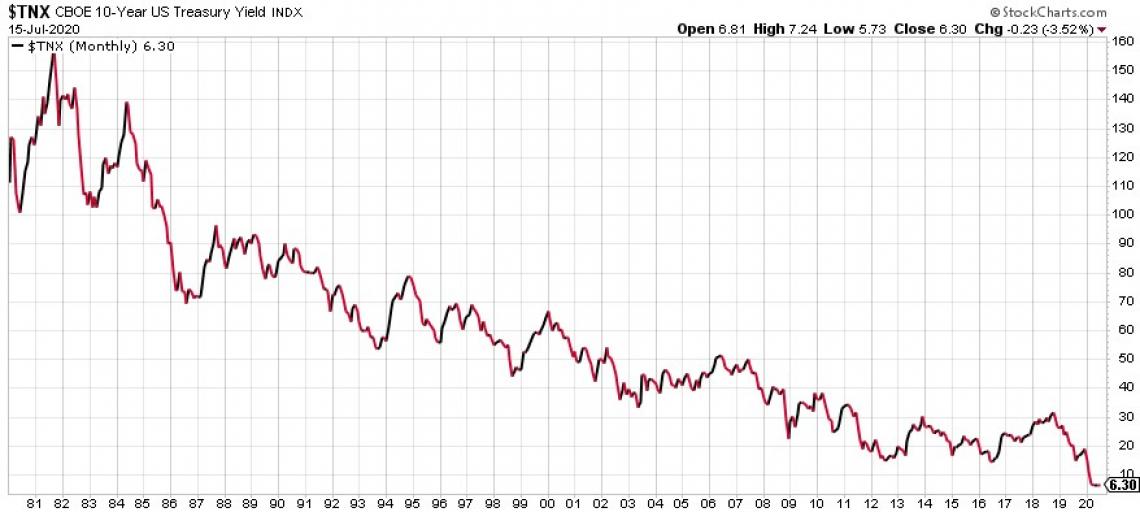
Leading up to and through the 1973 IBM, bond prices fell causing interest rates to rise in order to properly discount the inflationary pressures in the economy. Here’s a side-by-side comparison:
| Date | |||||
| 12/31/71 | |||||
| 12/31/72 | |||||
| 06/30/73 | |||||
| 12/31/73 | |||||
| 10/30/74 |
One of my favorite analysts, Steve Saville wrote the following in an interesting article about the relationship between bond yields and equities:
A downward trend in the bond market will eventually take its toll on the stock market. It’s a question of when, not if, a downward trend in the bond market will drag equities lower. The “when” is typically 5-7 months, but is sometimes as long as 12 months from the start of the bond market’s decline…The current situation is that bonds are about 6 months into a downward trend, so we have entered the time-window when weakness in bonds should be starting to have an adverse effect on the stock market.
He wrote this in June of this year when bonds were 6 months into their current sell-off. (While bonds depreciated through the course of last year, they rallied near the end of the year.) Mr. Saville goes on to say that the current situation in bonds will end one of three ways.
- Bonds will rally bringing yields back down.
- The stock market will correct sharply over the next few months.
- In similar fashion to 1987, bonds will rally for a bit but eventually sell-off even more and push the equities markets into a full scale bear market.
He thinks that Option #3 is the most likely, and I’m inclined to agree with him. While bonds may have a rally left, it is likely to be short-lived, as inflationary pressures are likely to persist. Furthermore, European central banks are expected to raise their overnight rate at least a couple of times this summer.
Engagement in an un-provoked, drawn out military action.
Whether the War in Iraq is justifiable or not (I’m not interested in making an argument either way) we have to consider the economic impact of Wars and why they often times lead to inflation. I’ll cover the two primary reasons why the War in Iraq will have an inflationary impact on our economy.
1. Wars are expensive:
The Congressional Budget Office delivered a report to lawmakers in July that estimated that the total bill for the War in Iraq will be at least $1T. The most liberal estimates at the beginning of the War were at $200B – 20% of the current estimate. We’ve already spent $500B.
The US government has gone deep into debt financing the War in Iraq. We can argue all day long about whether the war is worthwhile or not, but we cannot argue that we’ve accumulated massive amounts of debt paying for it and eventually the debt will need to be paid. An easy solution for our government is to devalue the currency and pay off the debt with cheaper nominal dollars. The downside to this strategy is that it is inflationary, but it is likely the best option.
2. Wars create enemies:
The second reason why the War in Iraq will be inflationary is that it gives the Middle East justification for using the “Oil Weapon”. The following is an excerpt from Jim Roger’s book Hot Commodities regarding the Oil Embargo of 1973:
What most people have forgotten (or never knew) was that the OPEC oil embargo had little to do with high prices. In the early 1970’s, long before the war, oil supplies were already tighter than they had been for decades. The huge US oil fields had already begun to decline. Oil producers no longer had the capacity to produce a surplus, while demand for oil was increasing. To stall inflation, the Nixon administration had put price controls on oil in 1971, discouraging investment in oil production or exploration and encouraging Americans to consume more oil…The Cartel’s most prolific producer, Saudi Arabia, had resisted “the oil weapon” but, before the war, in September of 1973 the Saudies finally agreed at an OPEC meeting in Vienna to summon the world’s major oil companies to confer about a price hike the following month in Vienna.
A month before the War broke out, OPEC had already decided to raise prices. All the war did was give OPEC justification for the embargo – which they conveniently used. Something they could point to and say “Look, you did this to yourselves, you foolish Americans.”
The inconvenient truth is that the “Elephant Fields” in the Middle East are losing production. They have pulled every trick in the book to keep pumping at an unsustainable rate; and when the inevitable decline in production takes place, the War in Iraq will allow them to project the blame onto the Americans. The next spike in oil prices will be supply driven – not demand driven – they just need a reason to allow it to happen. The following are some of the issues surrounding Middle Eastern Oil production:
- Saudi Arabia has not allowed a full audit of their largest oil field, Ghawar, since 1975. They haven’t permitted any sort of audit of their oil fields since the 90’s.
- OPEC does not police or audit their member countries. OPEC members are allowed to report their accounting numbers as whatever they see as reasonable. This allows OPEC members to engage in one-upping each other by claiming to have more reserves then the others.
- Many oil market prognosticators including Matt Simmons and T. Boone Pickens are calling for a significant reduction in the capacity of OPEC’s largest oil fields. Oil fields tend to lose 4-5% of their productivity each year. By their calculations, the “elephant” oil fields belonging to OPEC members should start seeing a significant decrease in production if they aren’t already. Currently, oil imports have decreased by double digits year-over-year.
We will not run out of oil in any of our great-great-grandchildren’s lifetimes. Canada has more oil than Saudi Arabia. There are tons of oil off our coasts and in Alaska. The problem is that the “easy” oil is running out. Getting usable oil out of the ground in Canada and other places is difficult and expensive – but it is there when we need it. I don’t foresee oil reaching any sort of ridiculous prices level, but it could get considerably more expensive in the short-term – which will provide the proper incentive to ramp up drilling efforts aimed at more difficult oil.
Government actively debasing our currency:
- Bloomberg, July 23, 2007 -
In August of 1971, President Nixon suspended the convertibility of the US currency into gold, thus effectively ending the Gold Standard in the US and worldwide. In one simple act, he did more to devalue our currency than any other president ever would or could do.
During the 90’s, the federal government maintained a “strong dollar policy” resulting in the US$ appreciating substantially. The trade-weighted US$ index increased approximately 50% from 1993 through 2002.
But since the beginning of 2002, the US$ has fallen by almost 1/3 and just broke through its all-time low. Despite rhetoric out of Washington, it is well-known that the US government is seeking to devalue its currency through various means. Paul Samuelson, the 1970 recipient of the Nobel Prize in Economics says, “The early line of the George Bush administration was that we want a strong dollar, [but over time] they began to want a depreciated dollar.” (Source, Bloomberg 7/23/07)
There is a strong consensus among top investors (Warren Buffett, Bill Gates, Marc Faber and Jim Rogers) that the US$ will continue to depreciate and erode its global purchasing power. I’m not wishing to make a statement on the merits of currency debasement. Lots of people feel very strongly one way or the other. I don’t. There are plusses and minuses to debasing a nation’s currency. Here is what I do know.
- Our government is seeking to debase our currency – as it did in the 70’s.
- A debased currency is inflationary.
Part IV Wrap-up:
Obviously, there are dissimilarities between today and the 70’s. To paraphrase Twain, “History simply rhymes, it doesn’t repeat itself.” There are a whole host of issues that I could point to that would differentiate what happened in the 70’s to what is happening today. The bear market in ‘68 wasn’t nearly as bad as the one in 2000 (however, valuations weren’t nearly as high in ’68 as 2000). We are not living in fear of a Cold War that could end in Nuclear Holocaust. Oil prices are not likely to go up 500% in just a few months, as they did in ‘73.
I’m simply trying to draw comparisons, and the closest economic situation to today’s is the 70’s. And for that reason, I think it is wise to play the odds and invest in a strategy that would have delivered superior performance during that period – such as the one we’re implementing at The MAC.
Investors and ordinary citizens have good reason to worry about a perfect economic storm: [1] A deepening loss of confidence in the dollar leading to higher interest rates, [2] the higher rates bringing a crashing end to a hedge-fund, private equity, and merger binge that has depended heavily on cheap borrowed money; [3] the boom in bait-and-switch mortgages ending in a morning-after of rising defaults and sinking housing values; [4] inflationary pressures in food, oil, and other commodities leading to still higher interest rates – all unsettling stock and credit markets and putting a new squeeze on consumers borrowed to the hilt..
- Robert Kuttner - Boston Globe, 7/30/07 -
While I’m not quite as pessimistic as Mr. Kuttner, I believe a steep sell-off in equities coupled with continuing price inflation is a strong possibility. In fact, I believe that without some sort of seismic shift in the economic landscape, an IBM is inevitable for the following reasons:
- The Necessity of Inflation
- Bond and Equity Fundamentals
- Leverage
- Ben Bernanke – Deflation Fighter
The Necessity of Inflation
It is necessary for our federal government to inflate the world’s economy because it will be the easiest means of correcting our country’s massive deficits. It’s really quite simple. When our economy was booming, we bought a ridiculous amount of oil from the Middle East and just about everything else from various Asian countries. In return, they invested in our government’s debt instruments (i.e. treasury bonds). Granted, they would have liked to buy other stuff, like ports and energy companies, but our congress wouldn’t let them; so they just kept pouring their imported US$’s into Treasuries. With interest rates already at historic lows, the inflow of US$’s just pushed prices higher and rates lower.
It’s actually an ingenious strategy on our government’s part. We stick foreign banks with bonds yielding 3-4% knowing full well we could just inflate the world’s economy which would lead to higher interest rates. Then we could invest our money in Eurobonds and other foreign Treasuries yielding 6-8%, pay off the 4% notes and keep the rest.
Market Fundamentals
Here are just a few of the fundamental issues with equities, bonds and real estate which have historically led to below average returns in each these asset classes:
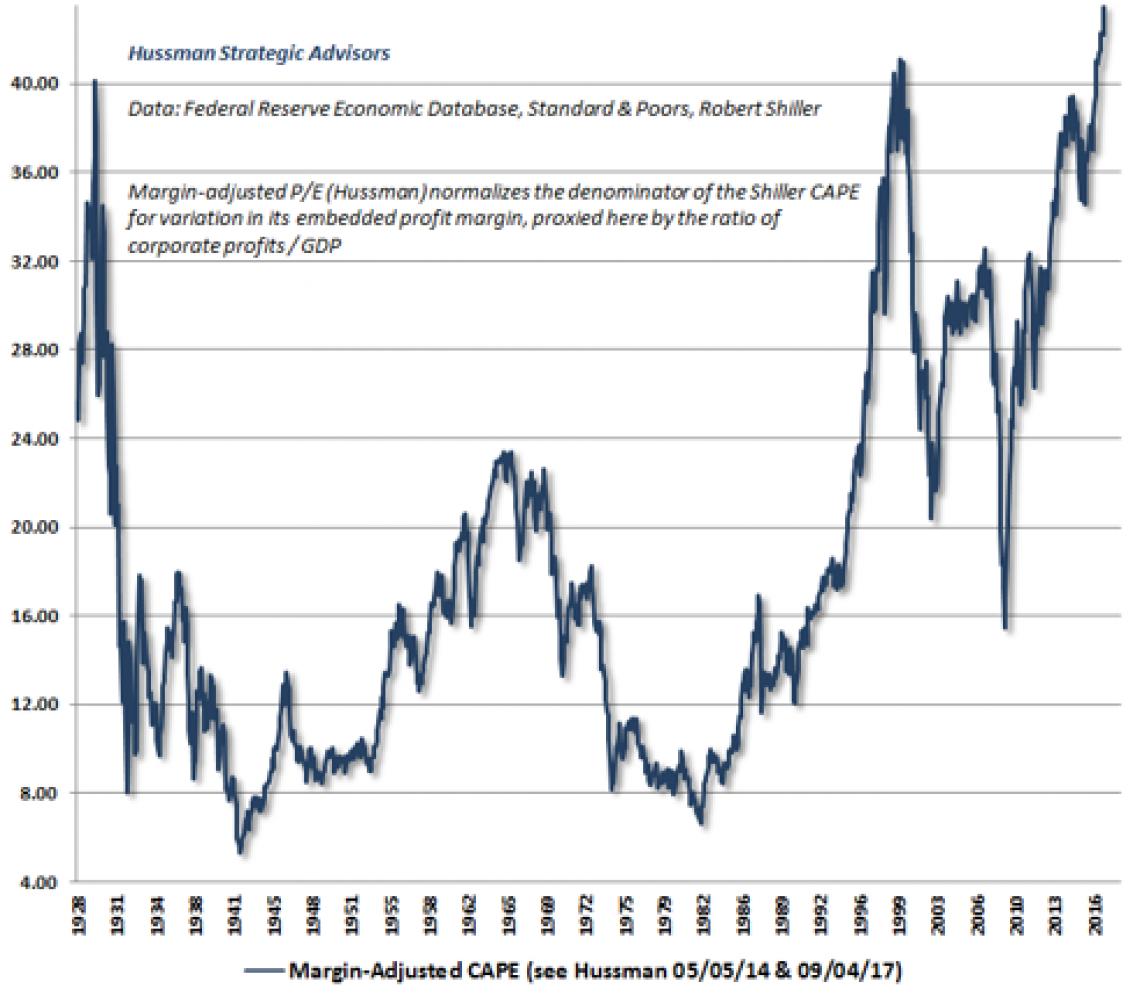
- The stock market’s valuation is well above its historical average of 14.5, while earnings growth has seemingly peaked and likely to decline.
- The market is currently experiencing its fourth longest bull market rally and its second longest stretch without a 10% correction.
- Yields on every type of income-generating security are at all-time lows (with the exception of some points on the Treasury curve). Utility stocks currently provide their lowest yield since 1930. REITs are 50% below their average historical yield. AAA bond yields are at a 40+ year low. The risk premium on junk bonds is at its lowest level ever (recently started to correct). As these yields improve and return to more normal levels, investors will exchange over-valued equities for higher-yielding securities.
- A slowing housing market, coupled with the oldest baby boomers now exiting their peak spending years, will likely result in a precipitous decline in US consumer spending, which currently accounts for 70% of the nation’s economy.
- Weakness in our nation’s currency will likely lead to a broad-based sell-off of US assets by foreign investors.
Leverage
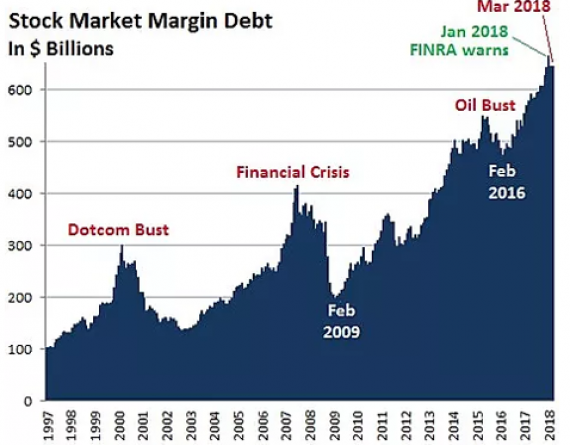
There is an unprecedented amount of leverage in the market. When this leverage is unwound, we could see an unprecedented sell-off in all assets! Steve Baily of the Boston Globe says that “Leverage is a wonder on the way up, and frightening on the way down.”
The first signs of the impact of leverage are now becoming apparent. Recently, news broke of two Bear Stearns Hedge Funds that lost everything – or at least next to everything. The amazing part of this story is that the funds were invested in real mortgages that had claims on real property that have real value. They were not invested in volatile natural gas futures like the Amaranth fund or a myriad of futures, swaps and other derivative products like Long-Term Capital Management.
The root cause for the demise of these funds was leverage. When a fund is levered up 10:1, as many are, a 10% loss in the underlying assets turns into a 100% loss for the fund. That’s how a fund filled with mortgage backed securities that own a claim on real property that has real value can go to ZERO in less than 6 months.
The implosion of the Bear Sterns’ funds will not be an isolated or “contained” event. More of these will come and as investors liquidate their Hedge Fund shares, the velocity of money coming out of the market will be “unprecedented”. Back in 2001, if an investor liquidated $1 from a mutual fund, the mutual fund had to liquidate 97 cents of equity exposure. When investors liquidate hedge fund shares, the fund has to unwind on average $5-$10 worth of equity exposure to redeem $1 worth of fund shares.
Ben Bernanke – Deflation Fighter
The man who is charged with navigating our economy, Fed Chairman Bernanke, is ultimately ill-suited to deal with stagflation. The Fed chairman earned the nickname “Helicopter” Ben for a speech where he claimed that we could defeat any sort of deflationary threat by figuratively dropping money from a Helicopter to increase spending. Bernanke did his Ph. D. dissertation on The Great Depression and how it could have been prevented through various means of stimulus. Pardon the sports analogy, but we have an offensive coordinator coaching the defense. His entire adult life has been spent focusing on defeating deflation – not inflation. Bernanke has had it easy thus far but he’ll start “waffling” on the topic of inflation as the economy begins to weaken.
back to top
Don’t be concerned if you are having trouble processing the information provided in this commentary. There are only two key points that you really need to come away with:
- The economy and securities markets are cyclical meaning that trends tend to repeat themselves over time. History suggests that IBMS occur every 30-40 years and given my fundamental research and technical analysis, I am convinced that the most plausible outcome for securities markets over the next 12-24 months is an IBM.
- IBMs have historically resulted in significant price depreciation in equities, bonds and real estate as a result of price inflation which in turn leads to higher interest rates. The end result will be significant losses in portfolios invested in a traditional asset allocation of diversified equities and bonds promoted by mainstream financial advisors.
At this moment, one of two thoughts is registering in your head. Either something you read caught your curiosity and perhaps struck a nerve. Maybe you found yourself agreeing with a point I made about inflation or deficits or the falling US$. If you fall into this category and you’re concerned about your portfolio, we welcome your call and would appreciate the opportunity to discuss your account. Our office number is 214.954.4300.
But the more prevalent response to my analysis will be simple rejection. There have been numerous studies that prove that when people are presented with unpleasant information, they make an emotional decision to reject the data despite its objective and logical nature. Married couples don’t seek counseling until they are on the brink of divorce. Addicts don’t seek treatment until they’ve “hit bottom”. After all, denial is the first step of the grieving process and you’re initial response is likely to be denial concerning what may soon take place in the equity markets. Agreeing with my analysis represents the need for change which leads to discomfort and as human beings we are naturally inclined to avoid uncomfortable decisions. This response is to be expected and perfectly acceptable.
The greatest revelations in my life have always been ones that I initially rejected. I doubt very few people will read this post and immediately pick up the phone to call us. So, allow me to suggest that you take the following steps to protect yourself just in case I’m even partially correct:
- Decide how much money you can afford to lose. (If you’re drawing an income from your account, you’re account should never fall below your draw divided by 5 or 6%.)
- Write down the amount – whether it is a percentage or dollar amount. Keep it handy, perhaps by your computer or on a card in your wallet. Don’t discard it or file it away (if you do, you’ll mentally adjust the amount down and will not hold yourself to it).
- Watch your account closely. I’d advise checking it weekly at a minimum. Also check it every day after the market closes down more than a percent and a half. (175 points on the Dow). This will drive your stock broker or financial advisor nuts but it’s your money – not his. He is deliberately trained to divert your attention away from short term swings in the market, which I think is advisable in normal markets, but we are entering a period of abnormality. (Normally, I would not recommend this but due to the precipitous decline in equity prices that accompany the beginning of an IBM, waiting a couple of months could make a significant difference.)
- The moment that your account reaches your “drop-dead” figure, call our office immediately. Our office number is 214.954.4300.
Allow me to close with just a couple of thoughts:
- I am completely agnostic about the direction of the market. I’m a tactical asset manager which means I play both the long and short side of the market. I’ve been long the market for three and half out of the last four and half years. I was in cash during the last bear market, the worst in two and half decades, and bought back into equities within weeks of the March ’03 bottom. I would prefer to write about how positively I view the outlook for equities and bonds but unfortunately the technicals and fundamentals do not support it.
- I have absolutely no incentive to be bearish on the market. I am not trying to sell a book or some kind of subscription trading service. I am simply trying to formulate an objective outlook on the market based on historical precedent.
Thank you for taking the time to read my commentary. I hope it was both informative and thought provoking. If you would like to discuss your portfolio, please call our office.